

Marrying a Second Son
If your Mama did not already explain this to you, I shall do my best to show you the way of the world.
So earlier this week I discussed what the genteel professions open to second sons — a.k.a. any son who isn’t the heir — actually were. Of course the untitled spare will never be quite as attractive as his older sibling, but that doesn’t make him a bad prospect, necessarily. So if your Mama did not already explain this to you, I shall do my best to show you the way of the world.
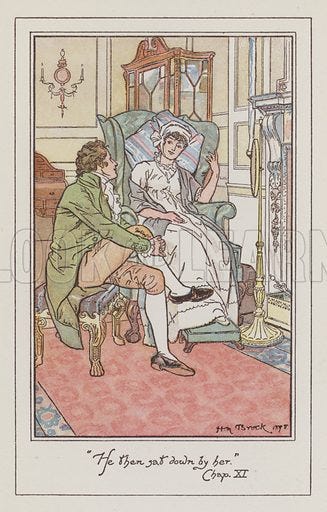
The Church
Are you looking for someone steady? Maybe he’s not the most exciting man in the room, and perhaps he is a little too into Fordyce’s Sermons, but he’ll be by your side through thick and thin.
In every respect except the small matter of his personality, Mr. Collins would have been an appropriate match. But for every Mr. Collins, there is a Mr. Ferrars. So don’t write off the entire profession. A vicar with a nice vicarage was certainly a worthy, if not particularly exciting, match for a woman of limited means.
And do not underestimate the appeal of security, dull as it sounds at nineteen. Assuming no scandals, he had a good living for life. The house came free with the position. He may bore you witless over the breakfast table, but you won’t worry whether breakfast is coming. Just be sure you’re being courted by the comfortable rector and not the curate scraping by on fifty pounds a year, for they wear very nearly the same collar.
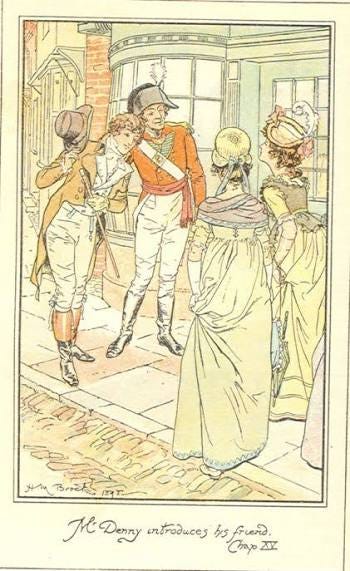
The Army
Are you looking for a dashing, decorated man? (Officers!) Then by all means throw your handkerchief towards the soldiers. You would hardly be the first girl to lose her wits over a scarlet coat, and you shan’t be the last. An officer is unimpeachably a gentleman; he dances beautifully, and he looks magnificent doing it.
But let’s hope you come with a hefty dowry. One cannot run a household on ninety-five pounds a year; one can scarcely run a wardrobe on it. The pay assumes he already has money of his own. If he doesn’t, that splendid coat will be cold comfort. Not to mention, in peacetime he may be set aside on “half-pay” and left to idle indefinitely on half of not-very-much.
So do make discreet enquiries about the family fortune before you surrender your… heart. A captain with means behind him is a fine catch indeed. A penniless lieutenant with charming manners and a fondness for the card table, I’m sorry to report, may be a Mr. Wickham.
The Navy
This is for the Venture Capitalists of the marriage mart. The naval man is a speculative investment: thrilling upside, genuine risk of total loss, and absolutely not for the faint of heart.
Unlike the army, he can’t simply buy his way up the career ladder, which means even a man of frankly obscure birth might end up in command of his own ship. (Hence why Sir Walter Elliot considered the navy a vulgar contrivance.)
His salary was modest, but salary was never the point. The point was prize money. Capture an enemy vessel, and the captain pocketed a full quarter of her value; one lucky day could remake a man entirely. Consider Captain Wentworth, who began with empty pockets and rejection and returned some years later with a fortune and the quiet satisfaction of having been right all along.
The danger is twofold. Fortune smiles on a lucky few. And, not everyone is as forgiving as Captain Wentworth.
The Law
Are you a patient woman? You had truly better be. Or perhaps open to an age gap relationship?
Becoming a barrister cost some two thousand pounds and the better part of a decade. And then, the young barrister embarked upon the most strenuous phase of his entire profession: waiting for a single soul to hire him. The polite term was briefless, and many a clever young man remained briefless for years, scribbling anonymously for the newspapers to keep himself afloat.
But should he arrive, the world is his oyster. An established barrister might clear four thousand pounds a year, up to even fifteen. And the law was the great ladder to everything else: the judge’s bench, a seat in Parliament, and, for the fortunate few, the Lord Chancellorship and a peerage of one’s very own.
So no, he is no great prize at five-and-twenty. But marry the man he is going to become, hold your nerve through the lean and chop-less years, and you may find yourself a baroness.
Medicine
Now, do mind the distinction here, because it matters enormously. The physician is a gentleman. The surgeon, who works with his hands, and the apothecary, who sells things, most emphatically are not.
What elevated the physician above his grubbier colleagues was precisely that he did neither. He held a university degree, he diagnosed in elegant Latin, and he merely suggested a charge. His fee was simply left, discreetly folded, somewhere about the room, so that no actual coin might be seen to change hands and offend the dignity of the occasion. He dined upstairs with the family; the surgeon ate below with the servants.
The East India Company
While colonialism underpinned much of the wealth creation regardless of the field, we cannot in good conscience endorse the Colonial Force.
Politics & The Professor
I have placed these two together because they share one delicate, disqualifying little secret: neither is, strictly speaking, a living at all.
Consider the politician first. A seat in Parliament paid precisely nothing. Politics was therefore never how a man made his money; it was something a man did once his money was safely made. The customary arrangement, I’m afraid, was to marry the fortune first and buy the seat second — so if a rising young politician is paying you particularly marked attention, that is a fact I would encourage you to sit quietly with for a moment.
And the professor? Charming, clever, and entirely unavailable. A fellowship at Oxford or Cambridge came with comfortable rooms, good dinners, and a tidy income — and one ironclad condition: that he remain unmarried. Should he wish to take a wife, he must first resign the whole arrangement, typically by accepting a parish living and reinventing himself as a clergyman — at which point, congratulations, you have wandered all the way back to the top of the list. As a suitor in his own right, the don is the single option on this entire list that the rules forbid outright. Do not, whatever you do, wait by the window for him.
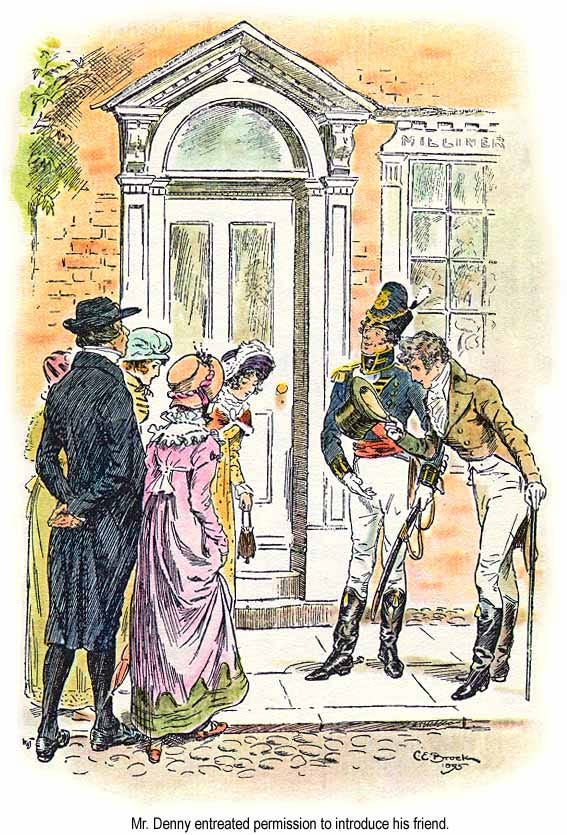
The Fortune Hunter
And now a word of warning, for not every gentleman who bows over your hand is selling what he pretends to.
The fortune hunter has no living, no prospects, and no intention of acquiring either by honest labour. What he has is charm, a fine coat bought on credit, and an unerring nose for large dowries. He will be the most attentive man in the room. He will listen to you as though you were the only soul worth listening to.
You know the type already, for the novels are simply stuffed with him: the Wickhams and the Willoughbys, all warmth and no income, forever pursuing the heiress and eloping with the fool. The cruel trick of it is that he is, very often, the most genuinely delightful company on offer all season.
So by all means enjoy the dance. Only do count the cost before you count on him.
Brilliant!! Really enjoyed this! To be honest I think I'd be better off single :)